

Silicon-based solar cells make up most of today's solar cells. They turn sunlight into electricity with an efficiency of up to 22%. Cells made of silicon, while cost effective, are brittle, like glass.
Scientists have long eyed cells with the perovskite crystalline structure as silicon's successor. "Tandem" cells, consisting of both perovskites and silicon can be manufactured more cheaply, as thin, flexible rolls of material and have reached efficiencies of 34% in the lab.
The biggest downside of perovskites has been that they quickly stop working when exposed to the atmosphere. But commercial cells are now starting to be produced.
Dr. Berry will bring us up to date.
This lecture is free and open to the public.
Science Speakers series
The last two decades have been a golden age in cosmology. Using some of the world's most powerful telescopes, astronomers have mapped the positions of hundreds of millions of galaxies, creating vast 3D surveys that serve as a time-lapse of the universe stretching back 9 billion years.
These maps are a powerful tool for testing our theories of gravity and investigating dark energy, the mysterious force driving the accelerating expansion of the universe. Drawing on experience in two major international collaborations, the Dark Energy Survey and the Dark Energy Spectroscopic Instrument, Noah Weaverdyck will discuss how this is done in practice, what we've learned so far, and some challenges and surprises that have come along the way.
Dr. Noah Weaverdyck, GC class of 2011, is a cosmologist and researcher at the Lawrence Berkeley National Laboratory.
Einstein showed that mass and energy are interchangeable. In terms of this "mass-energy", our universe seems to consist of around 68% dark energy, 27% dark matter, and only 5% normal matter that interacts with light (good ol' protons, neutrons and electrons).
Gravity causes mass (both dark and normal) to clump together, forming stars, solar systems, and galaxies.
Early in the 20th century, red-shifted light in all directions showed that the universe is expanding, Two groups studying supernovae in the 1990's found that this expansion is speeding up. Unlike gravity, something that we understand only dimly, now dubbed 'dark energy', is pushing mass apart.
We have no direct observations of dark energy! The prevailing model of big bang cosmology, Lambda-CDM, makes a simple assumption that there is a constant dark energy density throughout 'empty' space.
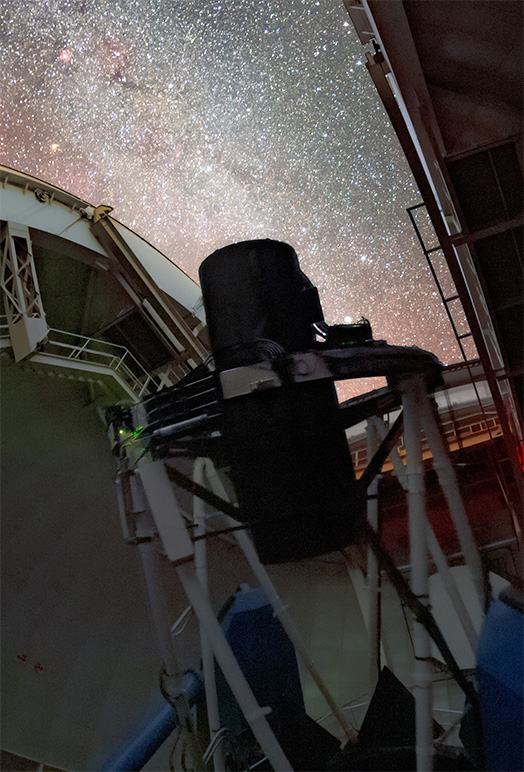
right: The Dark Energy Spectroscopic Instrument (DESI) making observations in the night sky on the Nicholas U. Mayall 4-meter Telescope at Kitt Peak National Observatory in Arizona.
KPNO/NOIRLab/NSF/AURA/T. Slovinský
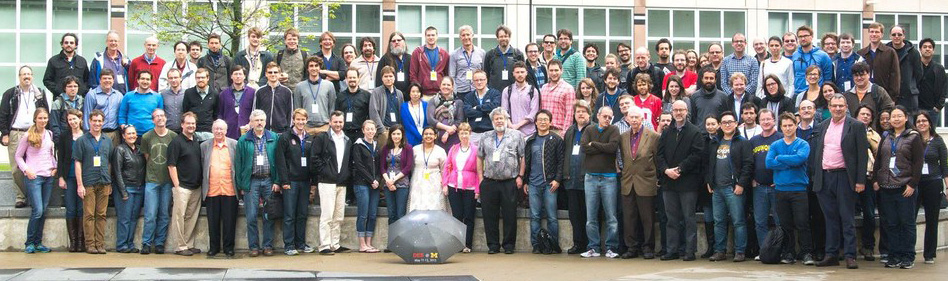
below: 2015 DES Collaboration Meeting at the University of Michigan
 Emma Burton will talk about her research project, building an ultraviolet laser for a thorium nuclear clock (NIST.gov). And about her experience in graduate school.
Emma graduated from Goshen College in 2022 and is working on her PhD at the University of Colorado, Boulder. She's part of the STROBE collaboration focussed on designing and building new kinds of microscopes.

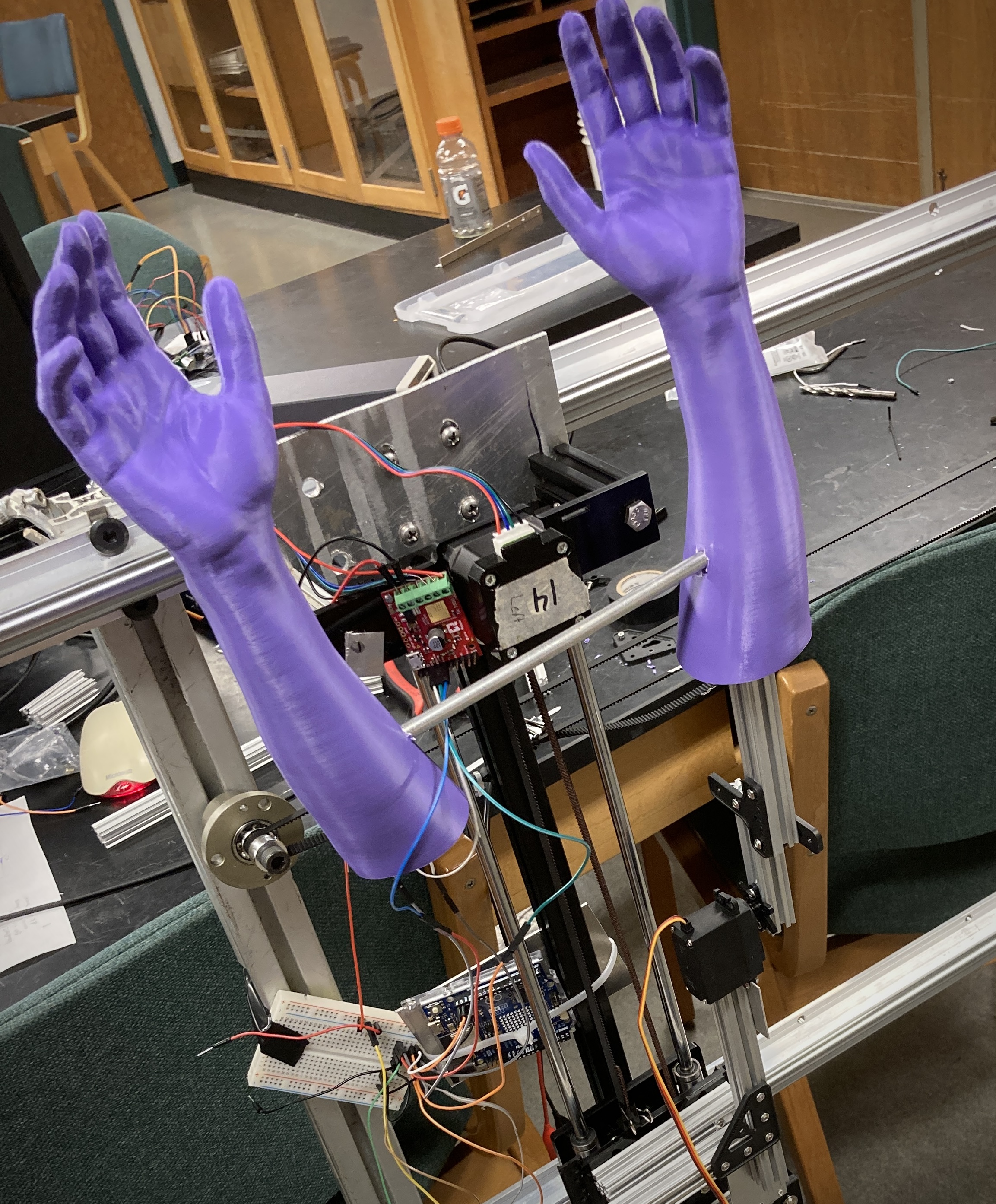
Students in the Electronics class taught by Prof. Paul Meyer Reimer spend the last month of class on a project. Each project uses the popular Arduino microprocesser programmed in C, controlling sensors, lights, sounds, motors and more.
This year's projects:

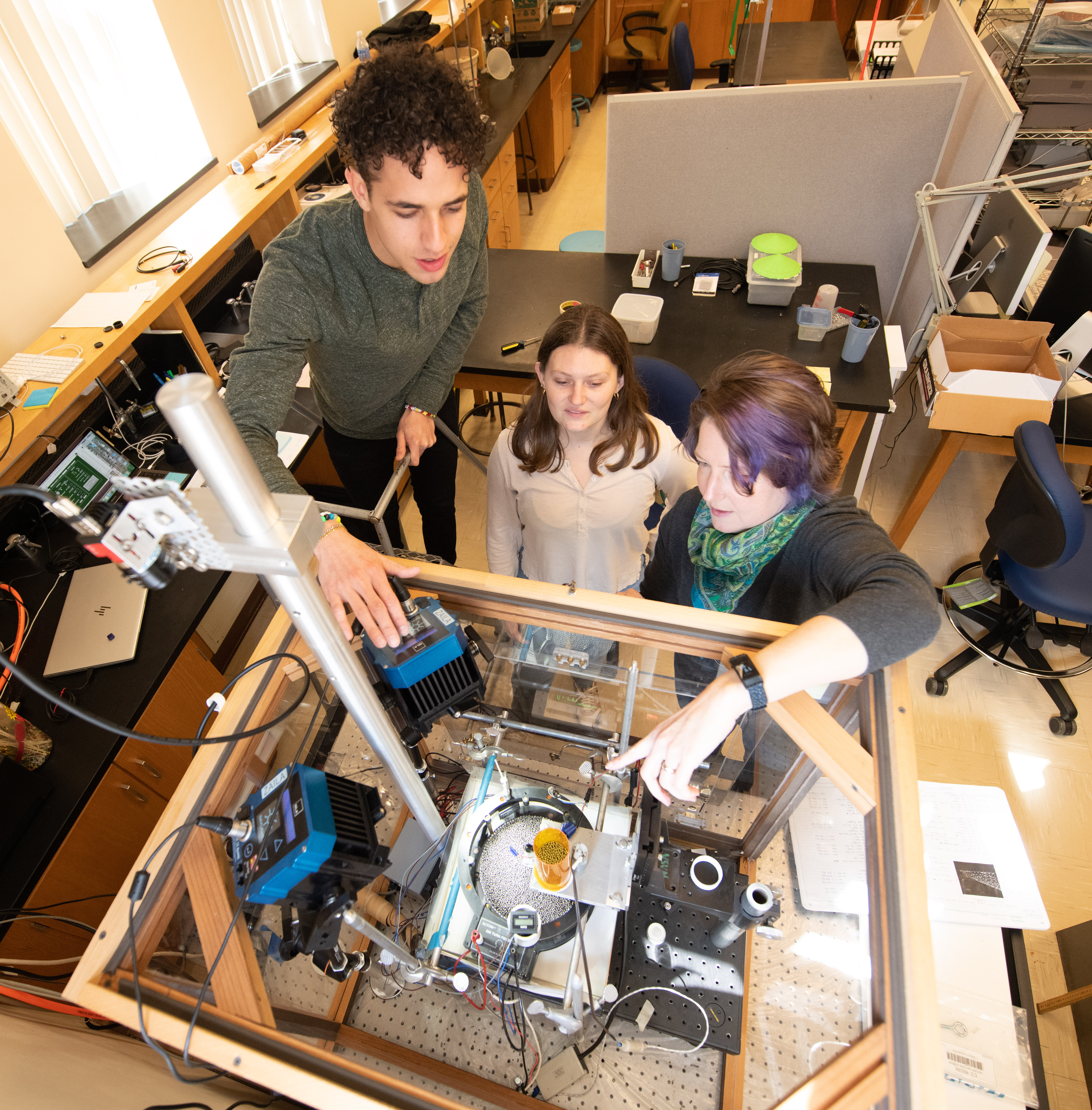
A granular system behaves in some ways like a liquid with an ability to flow and in some ways like a solid with a stable fixed structure if undisturbed. A tiny stimulus to the pile most often results in only a small response, but the same small stimulus can also create an unpredictable and catastrophic collapse of the pile.
Collapses occur both in natural settings, with hazards such as landslides and snow avalanches, and in industrial situations, where granular materials like sand or agricultural grains need to flow freely.
We use a simple experimental system – a 3D conical pile of uniform
beads – in order to model these real-world physical systems. We
investigate the dynamic response of the pile by recording avalanches
from the pile over the course of tens of thousands of bead drops.