Cylindrical and Spherical Coordinates [9.7]

Polar coordinates (2-d)
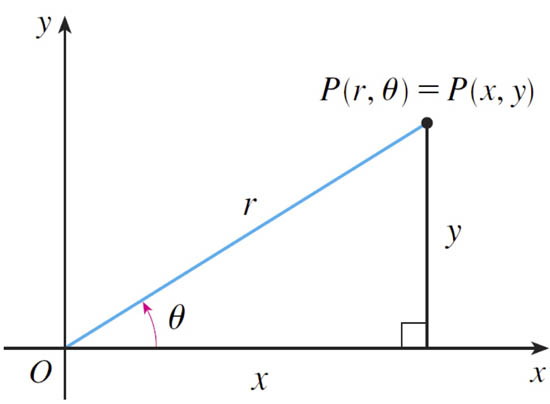
$(x,y)\to (r,\theta)$: $$r^2=x^2+y^2;\ \ \ \tan \theta = \frac yx.$$
$(r,\theta)\to(x,y)$: $$x=r\cos\theta;\ \ \ y=r\sin\theta.$$
Cylindrical coordinates (3-d)
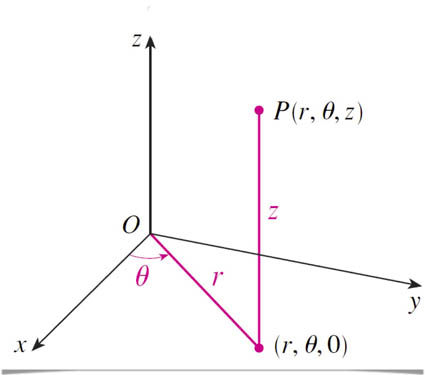 Polar coordinates in the $x-y-$plane, plus $z$ which is the same in cylindrical and Cartesian coordinates.
- Cylindrical Coordinates (*.nb)
"Cylindrical Coordinates" from the Wolfram Demonstrations Project,Contributed by: Jeff Bryant
For example
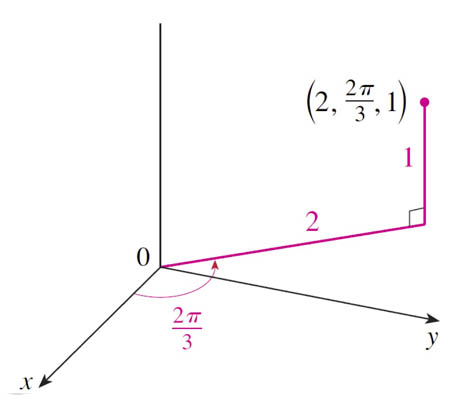 $(r,\theta,z)=(2,\frac{2\pi}{3},1)$:
- $x=r\cos\theta = 2 (-\frac 12)=-1$
- $y=r\sin\theta=2 (\frac{\sqrt{3}}{2})=\sqrt 3$
- $z=z=1$
[If an angle measure doesn't explicitly have the degree mark, ${}^o$, it's in radians.]
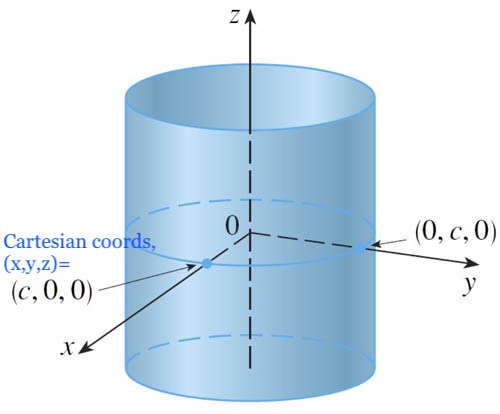
Some surfaces
...specified in cylindrical coordinates
$$r=c\nonumber$$
$$r=z\nonumber$$
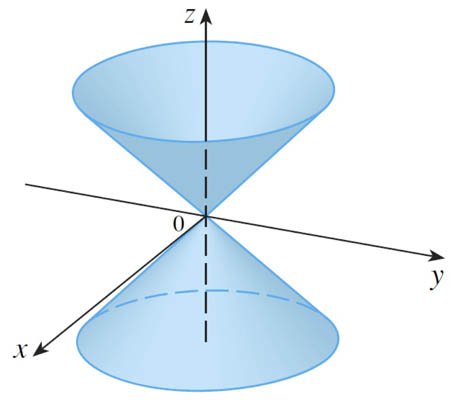
Spherical coordinates (3-d)
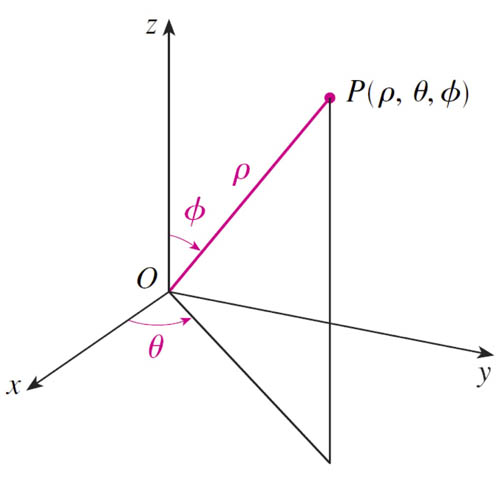
- $\rho$ - "rho" - [esc] r [esc] - radial distance
- $\theta$ - "theta" - [esc] q [esc] - azimuthal angle
- $\phi$ - "phi" - [esc] f [esc] - polar angle
This is the convention used by publishers of calculus textbooks, and Wolfram's own MathWorld website.]
- Animation at mathinsight.org
However, physicists, engineers, Mathematica, MatLab, and even applied mathematicians use a different convention, where $\theta$ is the polar angle and $\phi$ is the azimuthal angle.
:-<
-
Spherical Coordinates (*.nb)
"Spherical Coordinates" from the Wolfram Demonstrations Project,Contributed by: Jeff Bryant
$(\rho,\theta,\phi)\to(x,y,z)$
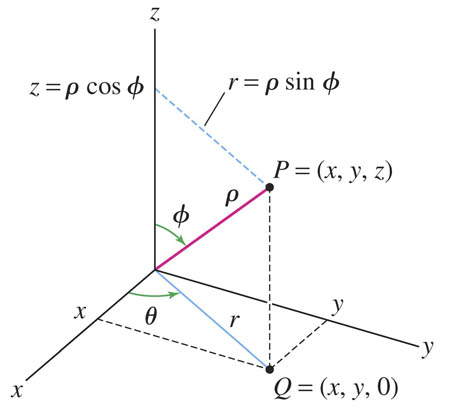
Use $r\equiv$ projection of $\rho$ into $x-y-$plane=$\rho\sin\phi$:
- $x=r\cos\theta = \rho \sin\phi \cos\theta.$
- $y=r\sin\theta = \rho \sin\phi \sin\theta.$
- $z=\rho \cos \phi.$
$(x,y,z)\to(\rho,\theta,\phi)$
- $\rho^2 = x^2+y^2+z^2.$
- $\tan\theta = \frac yx.$
- $\cos\phi =\frac z\rho.$
Discuss limits of angles phi and theta.
Example
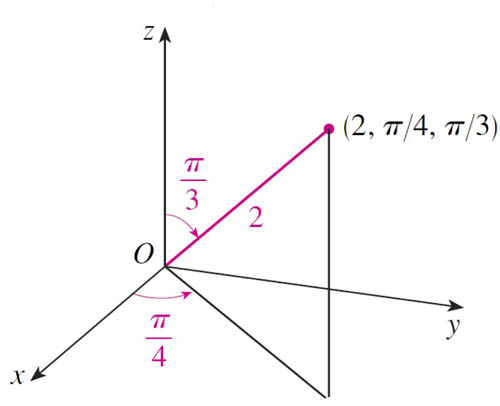
$(\rho,\theta,\phi)=(2,\pi/4,\pi/3) \to (x,y,z)$?
- $z=\rho \cos \frac{\pi}{3} = 1$
- $r=\rho \sin \frac{\pi}{3} = \sqrt 3$
- $x=r \cos \frac{\pi}{4}=\sqrt{3/2}\approx 1.22$
- $y=r \sin \frac{\pi}{4}\approx 1.22$
Surfaces in spherical coordinates
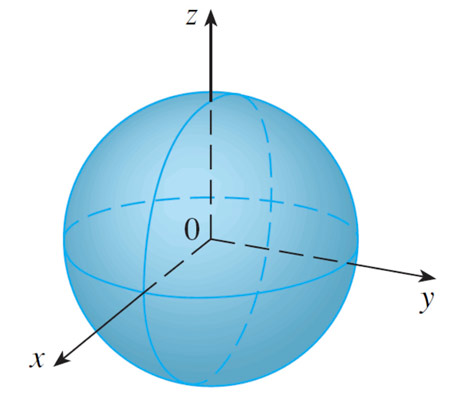
$$\rho=c$$
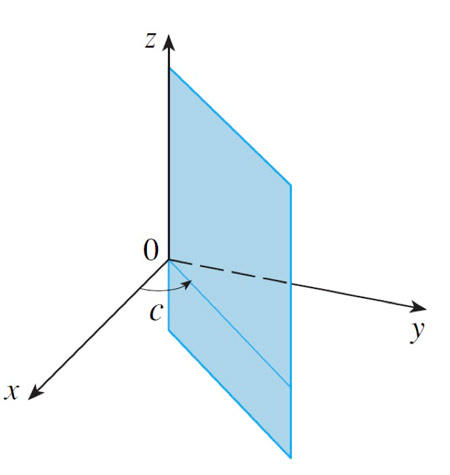
$$\theta=c$$
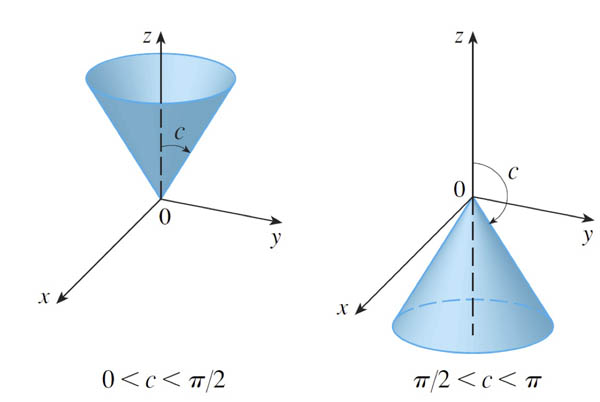
$$\phi=c$$
To do
 Describe me:
Come up with an expression (in cylindrical coordinates) to approximately describe the surface of a goblet. (Further detail about how to "hand in" this assignment in the "Space Curves and Surfaces" notebook file for today.)- Mathematica: Coordinates - worksheet (See Class 4 Resources for the notebook file.)